UNDER-RATED DESTINATION: SRI LANKA

I am often asked: what is the most under-rated destination that you have been to. My reply would be Sri Lanka with its stellar combination of World Heritage sites, wildlife, history, rich culture, terrific hotels, friendly people and a friendlier currency.

NOTHING BEATS QUEENSLAND!

I was in Queensland, Australia after many, many years and it was truly a wonderful experience filled with new friends, good wine and food and exciting travel.

IN THE MOST POPULOUS LAND IN THE PLANET!

Everyone’s talking about China...There is great interest in China as a travel destination .

UNDER-RATED DESTINATION: SRI LANKA

I am often asked: what is the most under-rated destination that you have been to. My reply would be Sri Lanka with its stellar combination of World Heritage sites, wildlife, history, rich culture, terrific hotels, friendly people and a friendlier currency.

NOTHING BEATS QUEENSLAND!

I was in Queensland, Australia after many, many years and it was truly a wonderful experience filled with new friends, good wine and food and exciting travel.

Of Flash mobs and Antwerp...

There’s so much talk about flash mobs and viral videos now- the best flash mob to date was the one I saw on 'You tube' some time ago, set in Antwerp Station.

Friday, May 25, 2012

A day at the Elephant Orphanage


We are at the Pinnewala Elephant orphanage about two and a half hours from Colombo. During the many years of civil strife, the Sri Lankan government started an elephant orphanage for the elephants that had lost their mothers or been separated from their herds or injured. Many elephants were injured by stepping on landmines as fallout of the civil war.  The farmers in villages keep out the marauding wild elephants by means of deep ditches. Sometimes baby elephants get trapped here and separated from their herds.


Elephants are used on all occasions of pomp and pageantry like the Kandy Perehara. During the times of the Sinhala kings, the elephants were protected completely by a royal decree and the punishment for killing an elephant was death. An estimated 3000 elephants lived in Sri Lanka before the arrival of the British in 1815. In the 1960s this was close to extinction!


There are more than 60 elephants at the orphanage. There are volunteers here who learn the nuances of elephant care over two to three months like feeding, giving them a wash in the river and grooming them.


The little ones are fed infant formula; the others are fed about 75 Kg of green matter everyday. We watch the elephants trundle down the dusty road in disciplined rows to the Maha Oya River led by their mahouts. The road is lined with souvenir stalls and curious tourists who watch the elephants and their antics. Once they are in the river they splash and gambol in the waters and the mahouts scrub them. The younger ones are the crowd-pullers as they hide beneath their mothers or cover themselves with a mud-pack, eliciting cries of “Awww, he’s so cute!” from the groups of Japanese and British tourists!

We hear that the rehabilitated elephants and those born in captivity are sent to other wildlife parks in the country or gifted to temples. There are elephants which have even been sent to foreign zoos.


We see a board advertising elephant dung paper and intrigued we enter the shop. There are sheets of paper, gift bags, wine bags, gift tags and even small storage boxes all made out of the elephant poop. The friendly owner explains that since the elephants are poor digesters of their food like bananas, fruits and leaves nearly 60% of what they eat is excreta!

Thursday, May 10, 2012

Green Haven


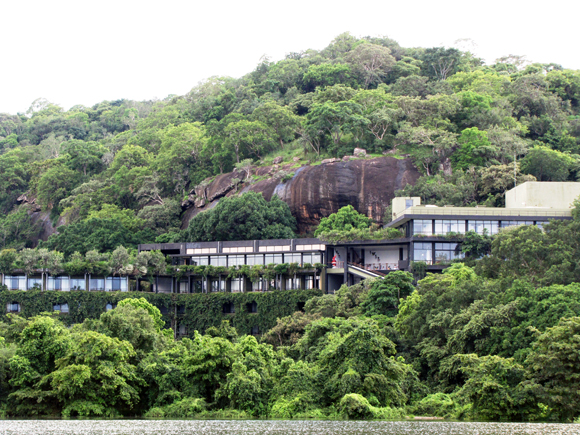
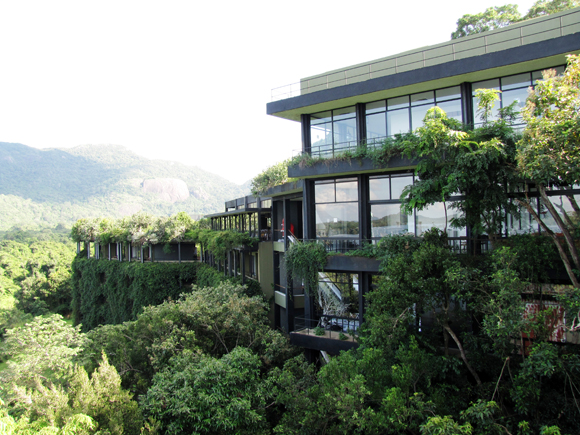
One of the most unique hotels that I have stayed at was the Kandalama Hotel, in Dambulla, Sri Lanka…


Apparently the design kept to the natural topography of the rock face. No rocks were injured during the building of the hotel; instead rooms and corridors were built around them!


The Kandalama Hotel is one of the world’s first eco-friendly hotels built much before ‘going green’ was fashionable. It was the brain child of genius architect and design guru the late Geoffrey Bawa.
Though it’s seven storeys high, it’s almost invisible from a distance as it has been sensitively fitted to its surroundings and covered with ficus, grass and jungle creepers.


It has won many awards and was the first hotel in Asia to receive the prestigious Green Globe 21 certification.


The rooms seem to be a natural extension of the verdant forest around as Hanuman langurs shriek and chatter, peering into our rooms from a ledge. The bathroom has a Jacuzzi facing a glass window with spectacular scenery outside and we voted it the best ‘bathroom with a view’.


We took a boat ride on the ancient Kandalama reservoir, and were astounded by the boatmen’s rich knowledge of bird life on the lake- Brahminy kites fly in the thermals, fish eagles swoop down on their daily catch, egrets and cormorants sit in the rushes, bee-eaters and colourful orioles flit by and the magnificent flight of the hawks is mesmerizing in the burnished gold of the setting sun.

Our days at the hotel were busy. The hotel has the unique distinction of being within the Cultural Triangle of Sri Lanka and is surrounded by UNESCO World Heritage sites. We visited the Dambulla Rock caves filled with frescoes and Buddha statues one day, and trekked up to Sigiriya, the ancient pleasure palace of King Kashyapa the next.

Friday, April 27, 2012

Prehistoric mystery...


There are places that cast a spell on you.. Newgrange is  on that list. A pagan dream of esoteric ceremonies and mystical dances. Time and space frozen into stone... Newgrange  which is a 30 minute drive from Dublin, Ireland, is older than the Pyramids and Stonehenge..


Newgrange is part of a heritage trail in Ireland, called Bru na Boine which includes the burial mounds of Knowth, Douth, and the Hill of Tara among others.
 The Newgrange site sits perched on a hill in the Boyne Valley with lush green pastures and hills all around. 
 

  The exterior of the mound is decorated with 97 large kerbstones(that are carved with intriguing spiral designs).


This tomb is called a passage tomb because of the long corridor leading to a central burial room. Were these sacred temples or astronomical observatories? Or territorial markers? Or were they a pagan homage to the seasons?  Nobody knows for sure.


 Our guide, Karlos warns us that those who are claustrophobic should think twice...We crept into the narrow passage, squeezing ourselves between closely placed rocks. The path went on a slight incline and then widened into an inner burial chamber built in the shape of a crucifix. 


The overlapping stones form an intricate conical roof and have been packed with burnt clay and sand. For millennia, the roof has been intact and kept the inner chamber dry.


 Many of the stones are decorated with ancient art- symbols like triangles, waves, spirals, lozenges and circles. Karlos tells us that this place has two thirds of all the known Neolithic carvings and they are similar to Aboriginal representations found in other parts of the world.

Maybe they represent symbols from nature: the sun, sky and the air? 

Newgrange is famous for its winter solstice when the rays of sunlight enter the roof box at the entrance, crawl into the passage, and fall on the inner chamber, illuminating it with golden light- the event lasts just 17 minutes. This incredible event is a great tourist attraction and tickets are sold by luck-of-the-draw lottery.         
                                                                                                 

Monday, April 23, 2012

48 hours in Ho Chi Minh City


Chaotic motor scooters, old wizened women with baskets on yokes, high rises rubbing shoulders with eclectic colonial architecture,luxe shops and bustling local markets and ubiquitous street food, Ho Chi Minh city in Vietnam or Saigon as it was called, is a frenetic city with an infectious energy.

We first visited District One which has most of the main attractions. Here is the Neo classical Municipal theatre and the Caravelle and the Continental hotels. The Continental Hotel was the haunt of writer Somerset Maugham and the setting of Graham Greene’s novel.


 The Notre Dame Cathedral standing in the heart of the government quarter on Dong Khoi, with a large square in front is dominated by a statue of the Virgin Mary. It is a piece of colonial France with bricks from Marseilles and glass from Chartres!


I loved the General Post Office close by built by none other than Gustave Eiffel. This has an old world ambience with a glass canopy, vaulted ceiling, vintage maps and old-fashioned telephone booths. Send a postcard by snail mail from here to your loved ones!


For a dose of local culture we watched a traditional water puppet show at the Golden Dragon Theatre. The water puppet show dates back to the 11th century and had its beginnings in the delta of the Red River where flooded paddy fields became stages. The stage is set on murky water and the puppeteers are behind a bamboo screen manipulating a complex system of strings and bamboo poles. The shows retell local folk tales whose storylines and humour are universal.


We visited a lacquer factory to see patient workmen using crushed duck’s egg shells and mother of pearl inlay to create masterpieces.


For a glimpse in to the city’s troubles past we went to the Re-unification palace, a 60’s style building which used to be the residence of the South Vietnamese President. This was where the communist tanks stormed the gates victoriously during 1975. There are boat shaped tables, carpets with dragons, regal staircases, receiving rooms with red chairs and heavy drapes. 


Local Transport- cyclos outside the market.

For our dose of retail therapy we headed to the chaotic BenThanh market which sells cheap material, glitzy ao dais, baskets and crafted bags, even roasted coffee beans. Bargaining is de rigueur here and a great place to pick up laquerware, snake wine, silk and silver jewellery.


 Loved this set of Vietnamese musicians in soapstone that I bought! Reminds me of this atmospheric city whenever I look at it....

Thursday, April 19, 2012

Water therapy...


One of the strangest places that I have visited is Karlovy Vary in the Czech Republic. This town’s therapeutic mineral springs attracted the rich and famous- its visitor’s book reads like a roll call of honour for the great people of their times like Goethe, Mozart, and Chopin.


We walked through a handsome boulevard in the centre of the town, where pastel Art Deco and Nouveau buildings festooned with shapely balconies, (many of them converted in to designer shops and hotels) competed for attention on both sides of the river.

The Grand Hotel Pupp
Our wedding cake- like Grand Hotel Pupp felt like the sets of a period drama- a Baroque excess with glittering chandeliers and red velvet panelling that has starred in several movies like Casino Royale and the Last Holiday.

Classic pavillions

There are pavilions and colonnades that dot this spa town. The Mill Colonnade is a long outdoor walkway built like a classical Greek temple with graceful columns
Small kiosks sell the special Karlovy Vary cups which look like miniature watering cans to drink the special water from the springs- the porcelain cups have a straw built in to the handle.
The typical cup for  drinking the water


Spa junkies

The taps with the spring water- the board tells you the temperature of the water.

Elderly people walk around clutching a stylish cup, filling it at the fountains and sipping on it in between their spa treatment appointments.

The Sprudel

There is the giant geyser called the Sprudel  which is the hottest spring here, belching scalding hot water and steam, 49 feet into the air at 72* centigrade enclosed in a giant glass building.


There are three things that are sold almost everywhere: the first is the ultra- thin wafers in different flavours called Oplatky which are meant to be nibbled on between sipping on the spring waters.
 The other is the famous Czech drink Becherovka also referred to as the ‘thirteenth spring’ which was invented by a pharmacist in 1807 and whose recipe is still shrouded in secrecy.

Moser Glass

The third thing is the famous lead-free Bohemian crystal which was first made here by Ludvic Moser in 1857. Visiting the Moser factory on the outskirts of the town, we were treated to a display of glass blowing. Every famous person owns a Moser glass...

Powered by Blogger.